
GAT Verbal Prep
About Course
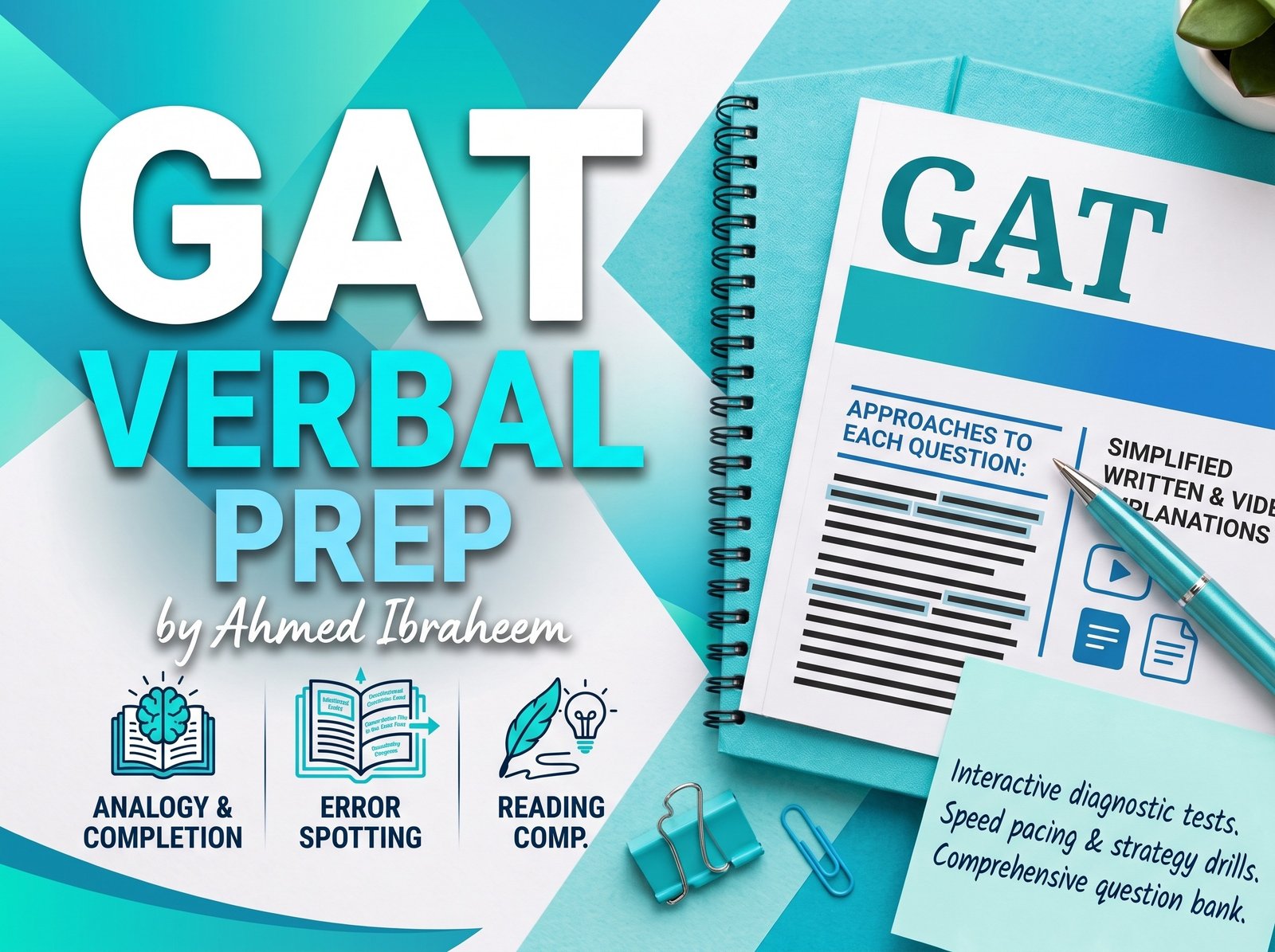
The GAT Verbal Master Prep course is an intensive, high-yield preparation program tailored specifically for students preparing for the English General Aptitude Test (GAT). Delivered across 27 one-hour private coaching sessions (3 lessons per week), this course utilizes an audit-and-apply instructional model designed to build core verbal reasoning skills, eliminate multiple-choice traps, and instill strict test-day time management before the mid-December exam date.
Course Structure & Methodology
The curriculum is built entirely on full question coverage, working through over 1,950 standardized GAT questions from the official Zama GAT Verbal textbook and specialized exam collections. Every instructional unit follows a rigorous two-part cycle:
-
Classwork (60 Minutes per Lesson):
-
Homework Error Audit (20–25 mins): Live, targeted breakdown of incorrect or flagged questions from previous assignments, analyzing trap patterns and underlying logic.
-
Strategy & Guided Practice (35–40 mins): Direct instruction in reasoning strategies, contextual analysis, and joint problem-solving of new question types.
-
-
High-Volume Independent Homework:
-
Guided, daily practice sets completed between sessions to build rapid recognition, reinforce vocabulary retention, and develop an average pacing target of 40–45 seconds per question.
-
Key Learning Modules
-
Module 1: Analogy Reasoning
-
Formulating logical sentence bridges to define relationships between word pairs.
-
Mastering degrees of intensity, part-to-whole relationships, functional associations, tools/actions, and antonym/synonym patterns.
-
-
Module 2: Sentence Completion
-
Decoding sentence context using transition signals (contrast indicators, cause-and-effect indicators, and restatements).
-
Handling complex single- and dual-blank sentences with precise connotation matching.
-
-
Module 3: Spotting Contextual Errors
-
Developing sharp semantic awareness to locate the single anomalous or illogical word within a text.
-
Spotting disguised antonym substitutions and grammatical context traps.
-
-
Module 4: Relationship & Difference (Odd One Out)
-
Categorizing semantic sets by classification, functional use, scientific attributes, and grammatical patterns.
-
Fast-track elimination of distractor options.
-
-
Module 5: Reading Comprehension Mastery
-
Strategic passage mapping and active keyword scanning.
-
Dissecting primary idea vs. detail-oriented questions, understanding inference traps, and avoiding “too extreme” or “too narrow” choices.
-
-
Module 6: Full-Length Timed Exam Modules
-
Completing complete, official practice test modules under strict exam timing.
-
Post-module review logs to address lingering weaknesses and solidify pacing before test day.
-
Course Content
Analogies
-
Approaching Analogy Questions
-
Lesson 1 :Analogy
-
GAT Analogy — Lesson 1 Classwork
-
GAT Analogy — Lesson 1 Homework (Part 1)
-
GAT Analogy — Lesson 1 Homework (Part 2)
-
GAT Analogy — Lesson 1 Homework (Part 3)
-
Lesson 2 :Analogy
-
GAT Analogy — Lesson 2 Classwork
-
GAT Analogy — Lesson 2 Homework (Part 1)
-
GAT Analogy — Lesson 2 Homework (Part 2)
-
GAT Analogy — Lesson 2 Homework (Part 3)
-
Lesson 3: Analogy
-
GAT Analogy — Lesson 3 Classwork
-
GAT Analogy — Lesson 3 Homework (Part 1)
-
GAT Analogy — Lesson 3 Homework (Part 2)
-
GAT Analogy — Lesson 3 Homework (Part 3)
-
Lesson 4: Analogy
-
GAT Analogy — Lesson 4 Classwork
-
GAT Analogy — Lesson 4 Homework (Part 1)
-
GAT Analogy — Lesson 4 Homework (Part 2)
-
GAT Analogy — Lesson 4 Homework (Part 3)
-
Lesson 5: Analogy
-
GAT Analogy — Lesson 5 Classwork
-
GAT Analogy — Lesson 5 Homework (Part 1)
-
GAT Analogy — Lesson 5 Homework (Part 2)
-
GAT Analogy — Lesson 5 Homework (Part 3)
Sentence Completion
Student Ratings & Reviews