
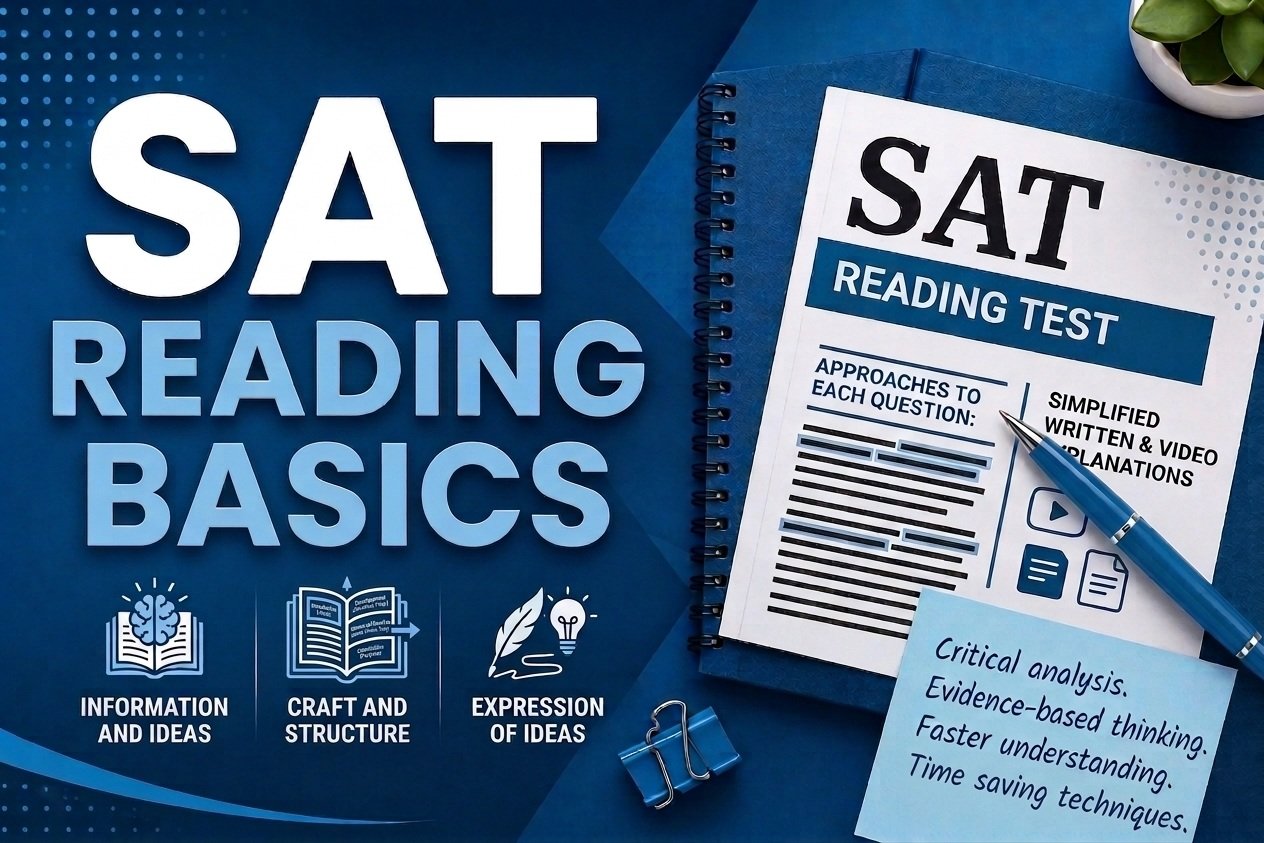
The course is structured around four primary pillars, which students will master to approach reading passages strategically:
1. Essential Reading Skills & Content Domains
Students will learn to categorize and analyze every question type by focusing on the core areas tested by the College Board:
-
Information and Ideas: Learn to perform close reading to determine central themes and main ideas. Students will practice citing textual evidence, understanding relationships, and interpreting quantitative data presented in charts and graphs.
-
Craft and Structure: Develop techniques for analyzing an author’s specific rhetorical choices. This includes understanding vocabulary in context, examining overall text structure, determining purpose, and evaluating point of view.
-
Expression of Ideas: Learn to evaluate the rhetorical effectiveness of how ideas are organized and expressed within a text, including analyzing transitions and effective language use.
2. Analytical Strategies for Higher Scores
Beyond basic comprehension, students will learn critical thinking techniques, moving beyond surface-level reading:
-
Critical Analysis: How to break down complex arguments and understand implicit meanings.
-
Evidence-Based Thinking: Developing a methodical approach to choosing answers that are directly supported by the text, not just plausible “traps.”
3. Efficiency and Time Management
A major focus of the course is mastering the timing of the exam through time-saving techniques and methods that build faster understanding.
4. Specialized Learning Formats
The course ensures comprehensive understanding through a blend of resources:
-
Approaches to Each Question: Specific step-by-step methods tailored to different question formats.
-
Simplified Written & Video Explanations: Accessible guides that break down difficult concepts and provide clear walkthroughs of official practice questions.
Reviews
There are no reviews yet.